Determine whether the entropy change is positive or negative for each of the following reactions, and explain the reasoning behind your predictions.
- \(KClO_4(s) \rightarrow 2KClO_3(s)+O_2 (g)\)
- \(H_2O(g) \rightarrow H_2O (l)\)
- \(2Na(s) + 2H_2O(l)\rightarrow 2NaOH (aq)+H_2(g)\)
- \(N_2(g) \rightarrow 2N (g)\)
Interpretation
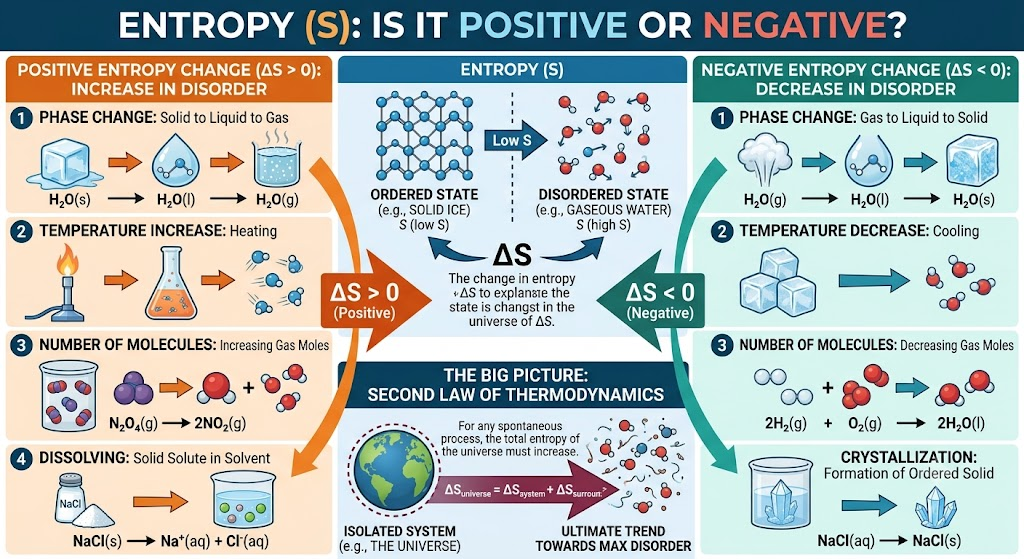
Entropy is a measure of the number of possible microscopic arrangements (or the degree of dispersal of matter and energy) in a system. A process that produces greater molecular freedom generally increases entropy, whereas a process that creates a more ordered arrangement decreases entropy.
A very useful guideline is:
because particles in gases have far greater freedom of movement than those in liquids or solids.
For many reactions, the change in the number of gaseous particles provides a quick clue:
An increase in gaseous particles usually means a positive entropy change, while a decrease usually means a negative entropy change. However, we should always interpret the physical change as well, not rely blindly on the formula.
(1) \(KClO_4(s) \rightarrow 2KClO_3(s)+O_2 (g)\)
Concept Application
The reactants contain only solids, while the products contain solids and a gas.
The formation of gaseous oxygen introduces particles with much greater freedom of motion than the solid reactants had.
Solution
Since gaseous molecules are produced, disorder increases significantly.
Entropy change is positive.
(2) \(H_2O(g) \rightarrow H_2O (l)\)
Concept Application
This is a condensation process in which water vapor becomes liquid water.
Gas molecules move freely throughout a container, whereas liquid molecules are much more restricted and remain close together.
Solution
The transition from gas to liquid reduces molecular freedom and randomness.
Entropy change is negative.
(3) \(2Na(s) + 2H_2O(l)\rightarrow 2NaOH (aq)+H_2(g)\)
Concept Application
The reactants contain a solid and a liquid, but the products include hydrogen gas.
The appearance of a gaseous product greatly increases disorder because gas particles occupy a much larger volume and have many more possible arrangements.
Solution
Since gas is formed during the reaction, entropy increases.
Entropy change is positive.
(4) \(N_2(g) \rightarrow 2N (g)\)
Concept Application
Here, one gaseous molecule breaks into two gaseous atoms.
Even though both sides are gases, the number of independent particles doubles. More particles mean more possible arrangements and therefore greater disorder.
Solution
Because the number of gaseous particles increases,
Entropy change is positive.
Insight
A powerful way to predict entropy changes quickly is to ask two questions:
- Is a gas being produced or consumed?
Producing gas usually gives ; consuming gas usually gives . - Has the number of gaseous particles increased?
More gaseous particles mean more possible arrangements and therefore higher entropy.
In fact, reactions (a), (c), and (d) all increase entropy for the same underlying reason: the system ends up with more freedom of motion in the gaseous state. Reaction (b) is the opposite case, where that freedom is lost during condensation.