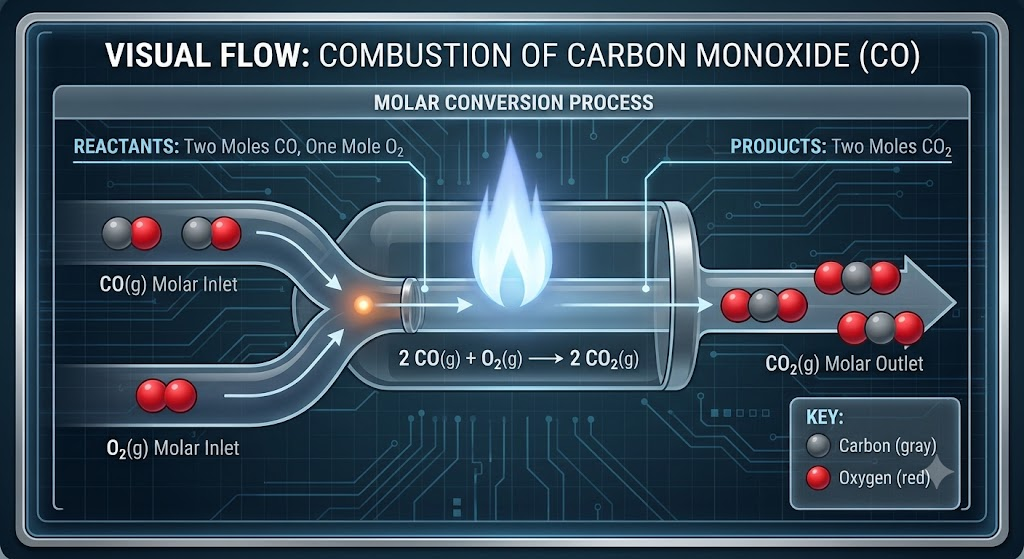
Calculate the change in internal energy, \(ΔE\), when 2 moles of carbon monoxide are converted into 2 moles of carbon dioxide at 1 atm and
\(2CO(g) + O_2(g) \rightarrow 2CO_2 (g)\)
Given:
\( ΔH=−566.0 kJ/mol\)
Interpretation
This problem asks us to determine the change in internal energy \(ΔE\) from the given enthalpy change \(ΔH\).
Although both quantities measure the energy change during a chemical reaction, they are generally not equal for reactions involving gases. The reason is that gases can expand or contract, causing the system to perform pressure–volume (PV) work.
The relationship between enthalpy and internal energy at constant pressure is
\( ΔE=ΔH − Δn_gRT\)
or, equivalently,
\( ΔH=ΔE − Δn_gRT\)
where
- \(Δn_g\) = change in the number of moles of gaseous species
- \(R\) = universal gas constant
- \(T\) = temperature in kelvin
The correction term \(Δn_gRT\) accounts for the energy associated with the expansion or contraction of gases.
Concept Application
The first step is to calculate the change in the number of gaseous moles.
The balanced reaction is \(2CO(g) + O_2(g) \rightarrow 2CO_2 (g)\)
The reactant side contains
\(2+1=3 moles of gas\)
while the product side contains \(2 moles of gas\)
Hence,
\( Δn_g = 2-3=-1 \)
Notice that only gaseous species are counted. Solids and liquids are ignored because they do not contribute significantly to expansion work.
Since the given enthalpy is expressed in kilojoules, the correction term must also be expressed in kilojoules. Therefore, after calculating \(RT\) in joules, we convert it to kilojoules.
Solution
Using the equation
\(ΔE = ΔH – Δn_gRT\)
Substituting the known values:
\(ΔH = -566.0 kJ \)
\(Δn_g = -1 \)
\(R = 8.314 J mol^-1K^-1\)
\(T=298 K \)
First calculate the correction term:
\(RT = (8.314)(298)=2477.6 Jmol^-1\)
Converting joules into kilojoules,
\(2477.6J/mol=2.48 kJ/mol\)
Now substitute into the equation:
\(ΔE = -566.0 – [(-1)×2.48]\)
\( = -566.0 +2.48 =-563.52 kJ/mol \)
Rounding to one decimal place,
\( ΔE =-563.5 kJ/mol\)
Final Answer
\( ΔE =-563.5 kJ/mol\)
Insight
Whenever a thermochemistry problem asks you to convert between enthalpy and internal energy, first check whether the number of gaseous moles changes.
- If \(Δn_g<0\), the number of gas molecules decreases, so \( ΔE\)is less negative than \( ΔH\)
- If \(Δn_g>0\), the number of gas molecules increases, so the number of gas molecules decreases, so \( ΔE\)is more negative than \( ΔH\)
Exam Tip: Before substituting into the formula, always count only gaseous reactants and products. Solids and liquids are never included in the calculation of \(Δn_g\), which helps avoid one of the most common mistakes in thermochemistry.