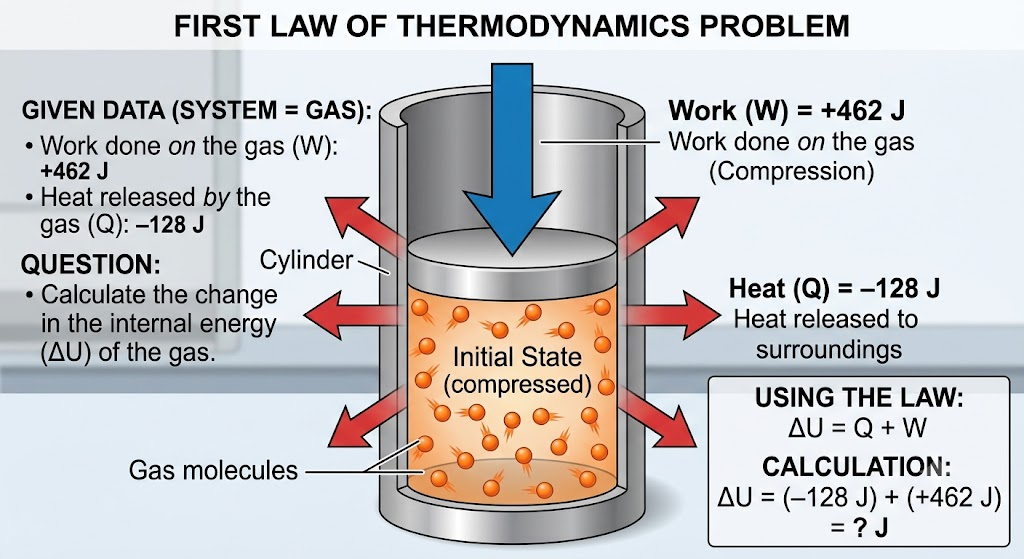
A gas is compressed inside a cylinder, and 462 J of work is done on the gas. During the same process, the gas releases 128 J of heat to the surroundings.
Using the first law of thermodynamics, calculate the change in the internal energy of the gas.
Interpretation
This problem is based on the First Law of Thermodynamics, which relates heat, work, and the change in the internal energy of a system.
The governing equation is:
\(\Delta E = q + w\)
where:
- \(\Delta E\) = change in internal energy of the system
- \(q\) = heat exchanged with the surroundings
- \(w\) = work done on or by the system
The most important part of such questions is assigning the correct signs to \(q\) and \(w\).
- If the system absorbs heat, then \(q > 0\).
- If the system releases heat, then \(q < 0\).
- If work is done on the system (compression), then \(w > 0\).
- If the system does work on the surroundings (expansion), then \(w < 0\).
A common mistake is to ignore these sign conventions. The calculation itself is simple once the signs are chosen correctly.
Concept Application
Here, the system is the gas.
The gas is compressed, meaning the surroundings push on the gas. Since work is done on the system,
\(w = +462\ \text{J}\)
The gas also releases heat to the surroundings. Heat leaving the system means
\(q = -128\ \text{J}\)
Now both quantities are ready to substitute into the First Law.
Solution
Using the First Law of Thermodynamics,
\(\Delta E = q + w\)
Substitute the given values:
\(\Delta E = (-128\ \text{J}) + (462\ \text{J})\)
\(\Delta E = 334\ \text{J}\)
Therefore,
The internal energy of the gas increases by \(+334\ \text{J}\).
Insight
A simple way to remember the sign convention is:
- Compression → Work done on the system → Positive \(w\)
- Expansion → Work done by the system → Negative \(w\)
- Heat enters → Positive \(q\)
- Heat leaves → Negative \(q\)
Think of internal energy like the balance in a bank account. Heat entering and work done on the system are deposits, while heat leaving and work done by the system are withdrawals. The net balance gives \(\Delta E\).