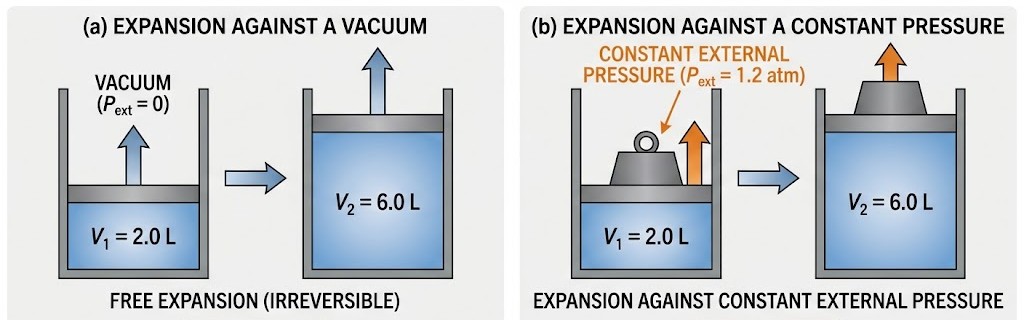
A certain gas expands in volume from 2.0 L to 6.0 L at constant temperature. Calculate the work done by the gas if it expands:
(a) against a vacuum
(b) against a constant pressure of 1.2 atm
Interpretation
This problem tests the concept of pressure–volume work done during the expansion of a gas.
When a gas expands, it pushes against its surroundings. If the surroundings exert an external pressure Pext , the gas must do work to move them. The work done is given bywhere
- \(w\) = work done by the system (gas)
- \(Pext\) = external pressure
- \(ΔV=Vf−Vi\) = change in volume
The negative sign is very important. It follows the chemistry sign convention:
- Expansion: the gas does work on the surroundings, so \(w<0\).
- Compression: the surroundings do work on the gas, so \(w>0\).
A common misconception is to use the pressure of the gas in the formula. The work depends on the external opposing pressure, because that is the force the gas must overcome.
Concept Application
The gas expands from
to
Therefore,
The temperature is constant, but notice that no gas law calculation is needed. Since the external pressure is already given, the work can be calculated directly from the pressure–volume equation.
Solution
(a) Expansion against a vacuum
In a vacuum,
Substituting into the work equation,
Reasoning
Although the gas expands, there is nothing pushing back against it. Since there is no opposing force, the gas performs no mechanical work on the surroundings.
(b) Expansion against a constant pressure of 1.2 atm
Here,
Using the work equation,
The SI unit of work is joule, so convert using
Therefore,
With appropriate significant figures,
Final Answers
(a) Against a vacuum
(b) Against a constant pressure of 1.2 atm
Insight
A simple way to remember pressure–volume work is:
- No external pressure ⇒ no work, regardless of how much the gas expands.
- The work depends on the external pressure, not the gas pressure.
- Keep the sign convention in mind:
- Expansion gas loses energy by doing work → w<0.
- Compression → surroundings do work on the gas → w>0.
A useful memory aid is:
This sign convention appears repeatedly in thermodynamics, so mastering it here will make later topics much easier.