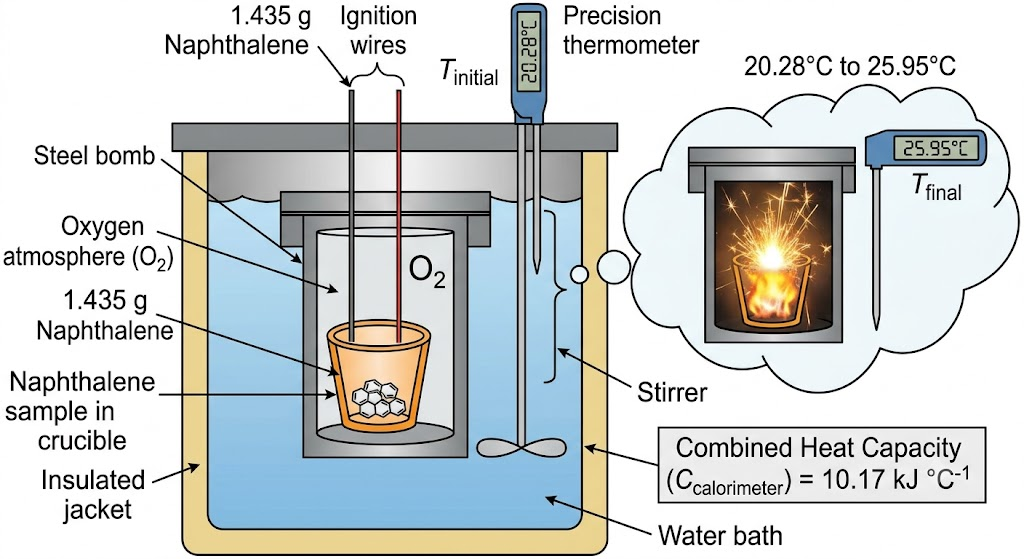
A sample of 1.435 g of naphthalene , a compound commonly used in mothballs, is completely burned in a constant-volume bomb calorimeter. During the combustion, the temperature of the calorimeter and the surrounding water increases from 20.28°C to 25.95°C. The combined heat capacity of the bomb calorimeter and water is 10.17 kJ °C⁻¹.
Calculate the molar heat of combustion of naphthalene.
Interpretation
A bomb calorimeter is designed to measure the heat released during combustion at constant volume. Since the calorimeter is well insulated, the heat released by the chemical reaction does not escape to the surroundings. Instead, it is absorbed entirely by the calorimeter and the water.
Thus, the heat lost by the reaction is exactly equal in magnitude to the heat gained by the calorimeter:
\( q_{{rxn}} + q_{{cal}} = 0 \)
or,
\( q_{{rxn}} = – q_{{cal}} \)
The negative sign indicates that combustion is an exothermic process, meaning the system releases heat while the calorimeter absorbs it.
Concept Application
The information provided allows us to calculate the heat absorbed by the calorimeter because both its heat capacity and the temperature rise are known.
The relationship is
\( q_{{cal}} = C_{{cal}}× ΔT \)
where
- \( C_{{cal}} = \) heat capacity of the calorimeter,
- \( ΔT = \) Change in temperature
Once the heat released by 1.435 g of naphthalene is obtained, it can be converted to a per mole basis using the molar mass of naphthalene.
Solution
Step 1: Calculate the temperature change
The temperature change is
\( ΔT = 25.95°C – 20.28°C = 5.67°C \)
Step 2: Calculate the heat absorbed by the calorimeter
Using \( q_{{cal}} = C_{{cal}}× ΔT \)
we obtain
\( q_{{cal}} = 10.17 kJ°C^-1× 5.67 °C \)
\( q_{{cal}} = 57.66 kJ \)
This is the amount of heat absorbed by the calorimeter.
Since
\( q_{{rxn}} = – q_{{cal}} \)
the combustion of 1.435 g of naphthalene releases
\( q_{{rxn}} = -57.66 kJ \)
Step 3: Calculate the molar mass of naphthalene
The molar mass is
\( (10\times12.01) + (8\times1.008)=128.2 g mol^-1 \)
Step 4: Convert the heat released to one mole
Using the conversion
\( (\frac{-57.66 kJ}{1.435 g}\times 128.2 g mol^-1) \)
we get
\( q_{{comb}} = -5.151 \times 10^3 kJ mol^-1\)
Hence, the molar heat of combustion of naphthalene is \( -5.151 \times 10^3 kJ mol^-1\)
The negative sign signifies that heat is released during combustion.
Insight
A useful idea to remember is that in calorimetry, the heat released by the reaction is always equal in magnitude and opposite in sign to the heat absorbed by the calorimeter:
\( q_{{rxn}} = – q_{{cal}} \)
Also, notice that calorimeters measure the heat released by a known mass of substance. To report the molar heat of combustion, always convert the given mass into one mole using the molar mass. This two-step approach ,first finding the heat for the given sample, then converting it to one mole works for nearly every combustion calorimetry problem.