Category: Thermo Chemistry

  • What is Calorimetry?

    What is Calorimetry?

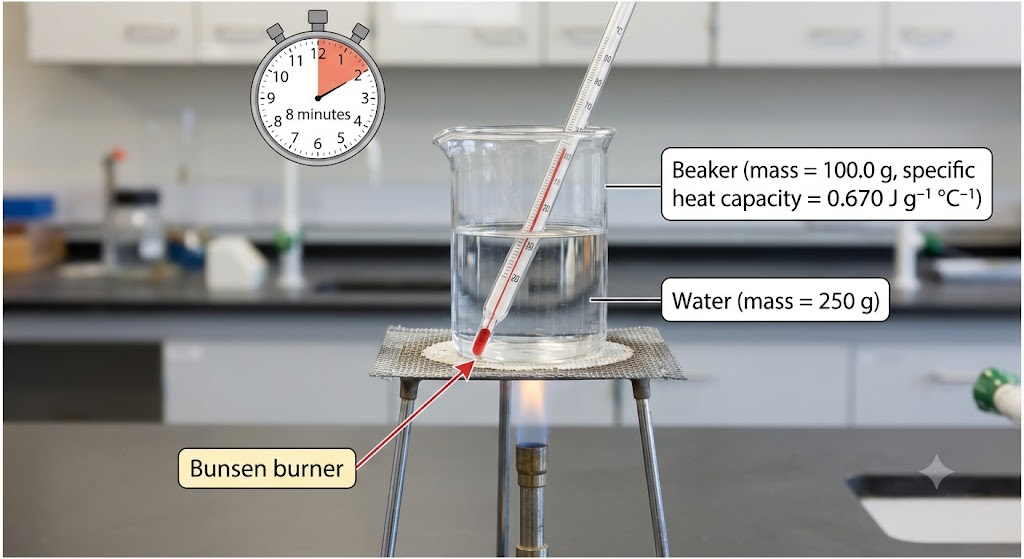
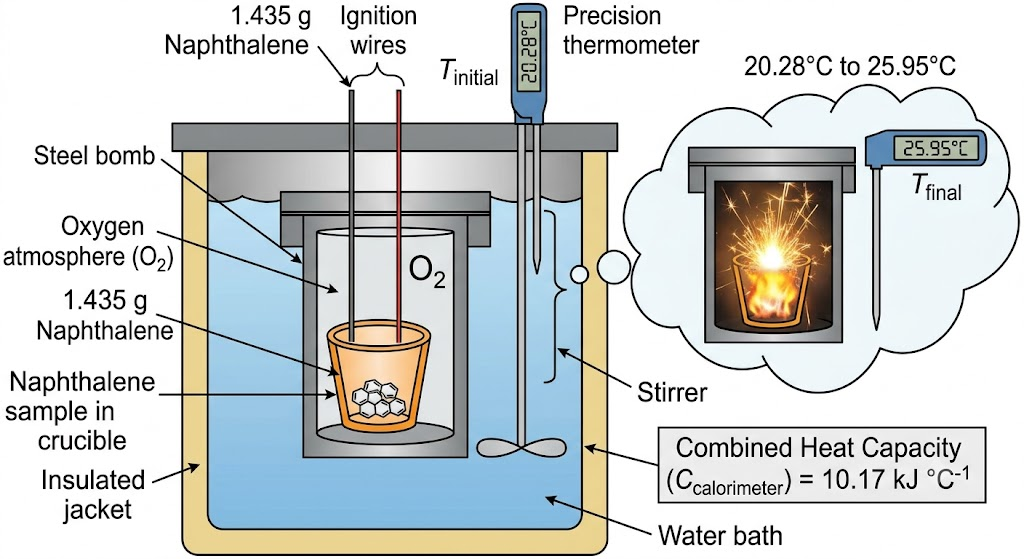
    Calorimetry is a technique which we use to measure the amount of heat released or absorbed during a reaction. To measure the heat of a reaction accurately, it is essential to isolate the system to avoid heat exchange with the environment. We accomplish this using a device known as a calorimeter.

    Calorimeter mainly consists of metallic vessels which are good conductor of heat such as aluminium and copper etc. The vessel includes a built-in stirring mechanism to mix its contents. This vessel is placed inside an insulated jacket to minimize heat loss to the surroundings. A single opening is provided for inserting a thermometer to monitor temperature changes during the reaction.

    Principle of Calorimetry

    The principle of calorimetry is based on the law of conservation of energy, which states that energy cannot be created or destroyed, only transferred from one body to another. When two objects at different temperatures come into contact, the object at the higher temperature transfers heat energy to the one at the lower temperature. This heat transfer continues until both objects reach the same temperature, a state known as thermal equilibrium.

    Example

    Consider a scenario where someone places a hot iron rod into a container of cool water. Since the iron rod is at a higher temperature and the water is at a lower temperature, heat will transfer from the rod to the water.

    As a result:

    • The temperature of the iron rod decreases.
    • The temperature of the water increases.

    This exchange of heat continues until both the rod and the water reach the same final temperature. According to the principle of calorimetry, the total heat lost by the hot object is equal to the total heat gained by the cooler one. Mathematically, we express it as follows:

    qwater + qiron rod = 0

    By rearranging this gives:

    qwater = – qiron rod

    Here, q represent the amount of heat transferred, we calculate it using the formula:

    q = mcΔT

    Where:

    • m is the mass of the substance (in grams),
    • c is the specific heat capacity (a material-specific constant),
    • ΔT is the change in temperature, calculated as:

    ΔT =Tfinal – Tinitial

    Where, Tfinal is final temperature and Tinitial is initial temperature.

    This formula allows us to quantify the heat exchanged between substances during thermal interactions and is fundamental in calorimetry calculations.

    Types of Calorimeter

    1. Bomb Calorimeter
    2. Coffee cup calorimeter

    Let’s discuss about these calorimeter in detail:

    1. Bomb Calorimeter: A bomb calorimeter is a device used to measure the heat of combustion of a substance. It functions based on the principle of calorimetry and operates by burning a sample in a sealed chamber filled with high-pressure oxygen at constant volume. Scientists refer to this sealed chamber as the “bomb” due to its design, which can withstand the force generated during combustion. In most bomb calorimeters, water surrounds the chamber as it absorbs the heat released during combustion process.
    2. Coffee cup Calorimeter: This calorimeter is a simple yet effective tool for measuring heat transfer during chemical reactions in liquid solutions. It operates at constant pressure and typically consists of two nested Styrofoam coffee cups with a lid to provide thermal insulation. Laboratories frequently use this type of calorimeter due to its convenience, affordability, and suitability for basic thermochemical experiments.

    Applications

    1. Food technologists can determine the energy content of food by measuring the heat released during combustion using calorimeter in food laboratories.
    2. Researchers can determine the specific heat capacity of a material by measuring the heat exchanged during temperature changes using calorimeter.
    3. Calorimetry is useful for analyzing medicines and other biological substances by measuring heat changes during molecular interactions, helping to understand their properties and effects.

    Limitations

    1. Assuming the solution is pure water:
    • In reactions involving aqueous solutions (like acids and bases), we often assume the solution has the same density (1 g/mL) and specific heat capacity (4.18 J/g°C) as water.
    • However, if the solution contains dissolved substances (like salts or acids), its actual properties may differ, leading to inaccuracies.

    2. Assuming no heat is lost to the surroundings:

    • In reality, some heat is always lost to the container or environment, especially in simple calorimeters like coffee cup calorimeters.
    • This causes the measured temperature change to be smaller than it would be in a perfectly insulated system, underestimating the true heat change.

  • Calculate Kp for the reaction H2 (g) + I2 (g) ⇄ 2HI (g) at 25°C

    Calculate Kp for the reaction H2 (g) + I2 (g) ⇄ 2HI (g) at 25°C

    Calculate Kp for the below reaction at 25°C:

    Solution:

    Interpretation: We will use the equation that describes the relation between equilibrium constant (Kp ) and Gibb’s free energy change (ΔG°).

    ΔG° = – RTlnKp

    Where, ΔG° = Standard free energy change

    Kp = Equilibrium constant in terms of pressure

    Given: ΔG° = 2.60 kJ/mol

    Solution: ΔG° = – RTlnKp

    Therefore, Kp for the reaction, H2 (g) + I2 (g) ⇄ 2HI (g) is 0.35 .

  • What is Gibb’s free energy?

    What is Gibb’s free energy?

    The concept of Gibbs free energy was developed by the American scientist Josiah Willard Gibbs. Initially, he termed it “available energy” to evaluate the spontaneity of chemical reactions in relation to change in entropy and enthalpy within the system. We denote Gibbs free energy by symbol “G”.

    Moreover, this energy is a state function, which means that it depends solely on the system’s current condition and is independent of the pathway taken to reach that condition.

    Formula

    Gibbs free energy is defined as the difference between the system’s enthalpy and the product of the temperature and the system’s entropy.

    G = H -TS

    Where,

    G = Gibbs free energy

    H = Enthalpy

    T = Temperature

    S = Entropy

    Gibbs Free Energy Change

    It is a thermodynamical quantity that gives the free energy at standard experimental conditions. As a result, to name the energy of a thermodynamic system as standard free energy, the reactants and products of that system should be at the standard conditions.

    ΔG = ΔH – TΔS

    Where, ΔG = Gibbs free energy change

    ΔH = Enthalpy change

    T = Temperature (in Kelvin)

    ΔS = Entropy change

    Gibbs free energy change and spontaneity

    This energy is utilized to determine whether a reaction is spontaneous, non-spontaneous, or at equilibrium.

    To proceed, we will apply ΔG formula to calculate the desired value of ΔG:

    ΔG = ΔH – TΔS

    Therefore, by determining ΔG, we can classify the process as spontaneous, non-spontaneous, or at equilibrium, based on the provided table.

    ΔGInterpretation
    ΔG>0Reaction is non – spontaneous
    (reaction is endergonic)
    ΔG<0Reaction is spontaneous (reaction is exergonic)
    ΔG=0The system is at equilibrium (there is no net change either in forward or reverse direction)

    Effects of delta H, delta S and T on spontaneity

    CaseΔHΔSΔGSpontaneity (yes/No)
    I+++(at low T)
    -(at high T)
    No (at low T)
    Yes (at high T)
    II++ (at all T)No
    III+– (at all T)Yes
    IV– (at low T)
    + (at high T)
    Yes (at low T)
    No (at high T)

    Example:

    Using the values of ΔH and ΔS, predict which of the following reactions will be spontaneous at 25°C:

    Reaction A: ΔH = 10.5 kJ/mol, ΔS = 30 J/K·mol

    If the reaction is non-spontaneous at 25°C, determine the temperature at which it may become spontaneous.

    Solution

    Interpretation: A spontaneous reaction is one that releases energy, and so the sign of ΔG must be negative. Change in free energy ΔG is defined as, ΔG = ΔH – TΔS .

    We have given the reaction with specific ΔH and ΔS values at a particular temperature, we will calculate the ΔG value using the formula provided. Subsequently, this will enable us to determine the spontaneity of the reaction.

    Reaction A: ΔH =10.5 kJ/mol , ΔS = 30 J/K.mol ,

    Temperature = 25 +273 = 298

    ΔG = ΔH – TΔS

    Since ΔG is positive, Reaction A is non-spontaneous. However, the reaction can become spontaneous when the temperature exceeds 25°C, as ΔG may become negative at that temperature, indicating spontaneity.

    Standard state free energy change for a reaction

    The standard free energy change for a reaction, represented by ΔG°rxn, is defined as the difference in the standard free energies of formation between the products and reactants. Therefore, it serves as an indicator of the reaction’s spontaneity under standard conditions.

    We can calculate standard free energy change by using the following formula:

    Where , ΔG°rxn = Standard entropy change for reaction

    n = stoichiometry coefficient for product

    m =stoichiometry coefficient for reactant

    = sum of

    Example: For reaction :

    In order to find ΔG°rxn , we will use this formula:

    Therefore, ΔG°rxn for the reaction  is 2 Mg (s) + O2 (g) → 2 MgO(s) is 1139 kJ/mol.

    Relation between Gibbs free energy (delta G) and Equilibrium constant (K)

    Let’s consider the following reversible reaction as

    A + B  ⇌  C + D

    The relation between delta G and equilibrium constant for the given reaction as:

    ΔG=ΔG°+RTlnQ

    Where, ΔG = Free energy

    ΔG° = Change in standard free energy

    R = ideal gas constant ( 8.314 J/mol.K)

    T = Absolute temperature in Kelvin

    Q = reaction Quotient

    At Equilibrium ΔG = 0, Q = Keq

    [ Keq for above reaction is :

    So, the relation at equilibrium is:

    0 = ΔG° + RT ln Keq

    ΔG° = – RT ln Keq

    Consequently, The equation  ΔG° = – RT ln Keq , describes the relation between ΔG°(standard free energy change) and Keq (Equilibrium constant). Specifically, R = Gas Constant and T = Absolute Temperature.

    In chemistry, this equation is a fundamental relation in thermodynamics, as it allows us to determine the equilibrium constant of a reaction when the change in standard free energy is known, and vice versa.

  • Determine the standard entropy changes for the following reactions at 25 degree Celsius:

    Determine the standard entropy changes for the following reactions at 25 degree Celsius:

    Determine the standard entropy changes for the following reactions at 25° C:

    (a) H2 (g) + CuO(s) → Cu(s) + H2O(g)

    (b) 2 Al (s) + 3 ZnO (s) → Al2O3 (s) + 3 Zn (s)

    (c) CH4 (g) + 2 O2 (g) → CO2 (g) + 2 H2O (l)

    Standard entropy values:

    SubstanceStandard Entropy (S°) (J/(K·mol))
    Cu (s)33.3
    CuO (s)43.5
    H2(g)131
    H2O(g)188.7
    Al(s)28.33
    ZnO(s)43.9
    Zn(s)41.6
    Al2O3(s)50.99
    CH4(g)186.2
    O2(g)205.0
    CO2(g)213.6
    H2O(l)69.9

    Interpretation: The standard entropy changes for a reaction, ∆S°rxn, is given by the difference in standard entropies between products and reactants. Thus, it reflects the change in disorder or randomness during the reaction.

    We can calculate Standard entropy changes by using the following formula:

    Where, ∆S°rxn = Standard entropy change for the reaction

    Solution:

    (a) H2 (g) + CuO(s) → Cu(s) + H2O(g)

    Therefore, the entropy increases by 47.5 J/K.mol for the reaction H2 (g) + CuO(s) → Cu(s) + H2O(g)

    (b) 2 Al (s) + 3 ZnO (s) → Al2O3 (s) + 3 Zn (s)

    Therefore, the entropy decreases by – 12.57 J/K.mol for the reaction 2 Al (s) + 3 ZnO (s) → Al2O3 (s) + 3 Zn (s).

    (c) CH4 (g) + 2 O2 (g) → CO2 (g) + 2 H2O (l)

    Therefore, the entropy increases by 242.8 J/K.mol for the reaction CH4 (g) + 2 O2 (g) → CO2 (g) + 2 H2O (l).

  • Determine whether the entropy change is positive or negative for each of the following reactions and explain the reasoning.

    Determine whether the entropy change is positive or negative for each of the following reactions and explain the reasoning.

    Determine whether the entropy change is positive or negative for each of the following reactions and explain the reasoning behind your predictions.

    1. 2 KClO4 (s) 2 KClO3 (s) + O2 (g)
    2. H2O (g) H2O (l)
    3. 2 Na (s) + 2 H2O (l) 2 NaOH (aq) + H2 (g)
    4. N2 (g) 2 N (g)

    Interpretation:

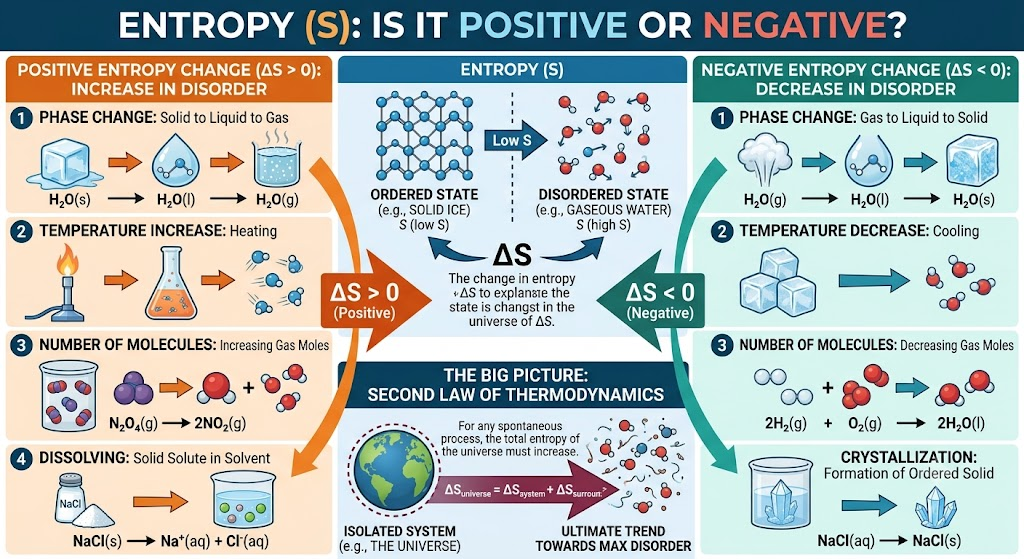
    Entropy is a measure of the randomness or disorder within a system. The higher the degree of randomness, the greater the entropy. Among the three primary states of matter, gases possess the highest entropy. The vapor state offers more space for molecules to move compared to the liquid state, and the liquid state provides more freedom of movement than the solid state. Water molecules are ordered more in the solid state than in the liquid or gaseous states. Hence, the entropy order is as follows: Ssolid < Sliquid < Sgas .

    Here, we aim to determine whether the entropy change is positive or negative in the context of the given reactions. To do this, we will examine the states of the reactants and products involved in the chemical reaction. If the number of gas molecules (∆ng) increases during the reaction, it results in an increase in entropy, indicating a positive entropy change. Conversely, if the number of gas molecules decreases, the entropy change will be negative.

    To calculate this, we will apply the appropriate formula.

    Formula

    (If ∆ng is positive, then entropy change will also be positive)

    1. 2 KClO4 (s) → 2 KClO3 (s) + O2 (g)

    ∆ng is positive, so the entropy change will be positive. Entropy will increase as more and more gas is created.

    2. H2O (g) → H2O (l)

     ∆ng is negative, so entropy change will be negative. The formation of liquid will decrease entropy as randomness decreases.

    3. 2 Na (s) + 2 H2O (l) → 2 NaOH (aq) + H2 (g)

     ∆ng is positive, so entropy change will be positive. The entropy will increase as more gaseous products are formed.

    4. N2 (g) → 2 N (g)

    ∆ng is positive, so the entropy change will be positive. The entropy will increase as more and more gas is created.

  • Calculate ∆G° for the following reactions at 25°C.

    Calculate ∆G° for the following reactions at 25°C.

    Calculate ∆G° for the following reactions at 25° C:

    (a) N2 (g) + O2 (g) → 2 NO (g)

    (b) H2O (l) → H2O (g)

    (c) 2 C2H2 (g) + 5 O2 (g) → 4CO2 (g) + 2H2O (l)

    Standard free energy formation values:

    Standard free energy formation (ΔG°f)kJ/mol
    N2 (g)0
    O2 (g)0
    NO (g)86.7
    H2O (l)-237.2
    H2O (g)-228.6
    C2H2 (g)209.2
    CO2(g)-394.4

    Interpretation

    To express the spontaneity of a reaction more clearly, we introduce thermodynamics’ function called Free energy or Gibb’s free energy (G). It is the energy available in the system to do useful work.

    Gibb’s free energy is defined as a thermodynamic equation equal to the enthalpy of a system, minus the product of the entropy and the temperature of the system.

    Where, G = Gibb’s free energy

    The value of Gibb’s free energy (G) is expressed in Joules or Kilojoules

    Formula

    We can calculate standard free energy change by using the following formula:

    Where,

    Solution:

    (a) N2 (g) + O2 (g) → 2 NO (g)

    Therefore, ∆G°rxn for the reaction N2 (g) + O2 (g) → 2 NO (g) is 173.4 kJ/mol.

    (b) H2O (l) → H2O (g)

    Therefore, ∆G°rxn for the reaction H2O (l) → H2O (g) is 8.6 kJ/mol.

    (c) 2 C2H2 (g) + 5 O2 (g) → 4CO2 (g) + 2H2O (l)

    Therefore, ∆G°rxn for the reaction 2 C2H2 (g) + 5 O2 (g) → 4CO2 (g) + 2H2O (l) is 2740.4 kJ/mol.

  • Which of the following processes occur spontaneously, and which occur non-spontaneously?

    Which of the following processes occur spontaneously, and which occur non-spontaneously?

    Which of the following processes occur spontaneously, and which occur non-spontaneously?

    1. Dissolving table salt (NaCl) in a steaming bowl of soup
    2. Electric current flowing from lower potential to higher potential
    3. Climbing Mount Everest
    4. Releasing the fragrance of perfume by simply removing the cap
    5. Isolating helium and neon from a mixture of gases

    Interpretation

    Here, we aim to identify which processes happen spontaneously and which do not. The key to understanding this lies in the fact that spontaneous processes occur naturally, without any external energy, while non-spontaneous processes need additional energy or effort to take place. By following this principle, we should be able to identify the spontaneous and non-spontaneous nature of the following processes.

    a. Dissolving table salt (NaCl) in a steaming bowl of soup

    When we add table salt (NaCl) to a steaming bowl of soup, the hot soup speeds up the dissolving of salt and does not require any external energy. Thus, this process is spontaneous as it does not require any external energy or effort and occurs naturally.

    b. Electric current flowing from lower potential to higher potential

    We know that electric current naturally flows from higher potential to lower potential. To make it flow in the reverse direction i.e., from lower potential to higher potential, an external energy source such as a power supply or battery is required. Since this process doesn’t happen by itself and needs an external energy source, it is considered a non-spontaneous process.

    c. Climbing Mount Everest

    Climbing Mount Everest requires preparation, extra effort, and energy, it does not happen naturally like rolling down a hill. Therefore, this is a non-spontaneous process.

    d. Releasing the fragrance of perfume by simply removing the cap

    As we open a perfume bottle, the fragrance naturally spreads into the surrounding air. We don’t need to provide any extra energy to make this happen. Therefore, this is a spontaneous process.

    e. Isolating helium and neon from a mixture of gases

    We require special methods like fractional distillation and specialized tools to separate helium and neon from a gaseous mixture. Thus, this is a non-spontaneous process as it does not occur naturally and requires external energy.

  • How does the entropy of a system change ?

    How does the entropy of a system change ?

    How does the entropy of a system change in each of the following processes?

    1. Melting of solid
    2. Freezing of liquid
    3. Boiling of liquid
    4. Conversion of vapor to solid
    5. Condensation of vapor to liquid
    6. Sublimation of solid
    7. Dissolution of urea in water

    Entropy

    In Thermochemistry, entropy is the degree of randomness or disorder in a system. The greater the degree of randomness, the higher the entropy, and vice versa. Entropy describes the spontaneous changes that occur in everyday life or the tendency of the universe towards disorder.

    For example, In the morning, when you clean your room and arrange everything neatly, the system has a higher order, however, as you begin your daily activities, especially cooking, things get messy. This is an example of how entropy initially appears lower in an organized state, but as disorder increases and things become more chaotic, the entropy increases.

    Entropy is a thermodynamic function that depends on the system’s state rather than the pathway followed. Entropy is an extensive property that scales with the system’s size or extent.

    Interpretation

    When we increase the temperature, entropy increases. Adding more energy to a system causes the molecules to become more excited, leading to greater randomness. The more random the system, the higher the entropy. Now, let’s determine the change in entropy for the following scenarios:

    a. Melting of solid:

    In its solid state, ice has molecules fixed in an ordered structure. As it begins to melt, the molecules gain mobility, leading to increased disorder and consequently greater randomness. A higher degree of randomness corresponds to higher entropy. Since the liquid state is more disordered than the solid state, the system’s entropy increases when ice melts.

    b. Freezing of liquid

    When a liquid freezes, its molecules become more ordered, resulting in a solid with a fixed structure and less randomness. As a result, the degree of disorder decreases. Hence, entropy decreases during the freezing process of liquid.

    c. Boiling of liquid

    When a liquid begins to boil, the molecules gain more freedom to move independently, which leads to an increase in randomness. The more random a system, the higher its entropy. Since the gaseous state is more random than the liquid state, entropy increases when the liquid turns into gas.

    d. Conversion of vapor to a solid

    When vapor turns into a solid, the molecules have less freedom to move, causing the level of randomness to decrease. As a result, entropy decreases because the water molecules are more organized in the solid state than the vapor state.

    e. Condensation of vapor to liquid

    Vapor molecules have more free space to move compared to liquid molecules. Molecules become more organized when the vapor turns into liquid and the randomness decreases. Therefore entropy decreases.

    f. Sublimation of solid

    When solid sublimes, it is converted to vapor state. As molecules are more ordered in the solid state than the gaseous state, the randomness in the gaseous state is greater, and therefore entropy increases.

    g. Dissolution of urea in water

    When urea dissolves in water, it forms solid crystals or pellets and is highly soluble. The process of dissolving urea involves transitioning from a more ordered solid state to a less ordered liquid state. As the urea dissolves, the randomness increases, resulting in increased entropy.

  • What is Thermochemistry?

    What is Thermochemistry?

    Thermochemistry is the branch of chemistry in which we study the heat energy involved in chemical reactions and phase changes, such as melting and boiling. For example, adding heat to ice can change its state from solid to liquid.

    Thermochemistry helps us explain how much heat is released or absorbed quantitatively.

    Thermochemical reactions are classified into two categories:

    1. Exothermic Process, and
    2. Endothermic Process

    1. Exothermic Process:

    In an exothermic process, the system releases heat energy into the surroundings, resulting in an increase in the surrounding temperature. This release of energy illustrates an exothermic process.

    Example:

    • Making ice cubes: As the temperature of the water decreases and it transitions from liquid to solid, it releases heat into the surroundings. This release of heat characterizes exothermic reactions, where the system releases energy rather than absorbing it.
    • Mixing water and strong acid: When we mix acid into water, they react vigorously, releasing heat energy into the surroundings. This release of heat conveys an exothermic reaction.

    Note: Always add acid to water, not the other way around, as adding water to acid can cause it to splash or erupt violently.

    2. Endothermic Process

    In an Endothermic process, the system absorbs heat energy from the surroundings, thus decreasing the surrounding temperature.

    Example:

    • Cooking an egg: Egg absorbs heat energy from the pan or water, causing changes to its internal structure. This transformation is what cooks the egg and is characteristic of an endothermic process, where the system absorbs energy.
    • Melting ice cubes: During melting, ice absorbs heat from the surroundings, which is characteristic of an endothermic process. In this process, the temperature of the ice stays constant at the melting point (0° C ) during the phase change from solid (Ice) to liquid(water). The temperature will only increase when the ice completely melts and we continue adding heat.

    Enthalpy of reaction: Enthalpy is used to measure the energy in a system.

    When a chemical reaction is given, we can find out the change in enthalpy by the following formula:

    ΔHrxn = ∑ΔHproducts – ∑ΔHreactants

    Where,

    ΔHproducts = Sum of total enthalpy absorbed/released by the products

    ΔHreactants = Sum of total enthalpy absorbed/released by the reactants

    We can use the above formula to identify whether the reaction is exothermic or endothermic. If ΔH reaction is positive, the reaction will be endothermic, and if ΔH is negative, the reaction will be exothermic.

    Energy

    Energy is the capacity to do work. In thermochemistry, we prioritize heat energy (the heat exchange between a system and its surroundings during phase change and chemical reactions).

    Energy Transfer

    As the term suggests, energy transfer refers to the movement of energy from one system or object to another. In thermochemistry, energy transfer specifically refers to the flow of energy, primarily in the form of heat or work, due to differences in temperature, pressure, or other conditions.

    Latent heat

    Latent heat is the heat energy necessary to change the phase of a substance or object from solid (Ice) to liquid (water), liquid (water) to vapor (gas), and vice versa when its temperature is constant.

    There are mainly two types of latent heat:

    1. Latent heat of fusion: We denote the latent heat of fusion by ‘Hf’. Latent heat of fusion is the heat energy required to melt a solid (Ice) without changing its temperature. When ice melts, only the phase changes. The temperature remains at 0° C, and the liquid water that forms with the phase change will also be at 0° C.
    2. Latent heat of vaporization: We denote latent heat of vaporization by ‘Hv‘. Latent heat of vaporization is the heat energy required to vaporize liquid(water) without changing its temperature.

    Sensible heat

    Sensible heat is the heat energy required to change the temperature of a substance without changing its phase.  This heat is the opposite of latent heat where phase changes without changing temperature.

    The formula to find sensible heat is Q = mcΔT

    Where Q = heat energy

    m= mass of substance or object

    c=specific heat

    ΔT =difference in temperatures (Tf – Ti)

    Specific heat

    It is denoted by ‘c’. Specific heat is the quantity of heat required to raise the temperature of 1 g of substance by 1 degree Celsius or 1 kelvin.

    Calorimetry

    Calorimetry measures the heat energy absorbed or released during physical or chemical changes. It involves an instrument calorimeter for monitoring and quantifying the heat exchange.

    Principle of calorimetry: When two objects or substances with different temperatures come in contact, the heat transfers from hotter objects to colder objects until they reach thermal equilibrium. Here, the Principle of calorimetry indicates the law of conservation of energy. The total heat lost by an object equals the total heat gained by the other object.

    Hess’s law

    Hess’s law states that the total enthalpy change for a reaction is the same whether the reaction takes place in one or more than one step.

    Mathematically, we express it as ΔHtotal =∑ΔHsteps

    For example:  Consider we have a reaction:  X → Y

    If we can break it into two steps:

    X → Z(ΔH1)

                                                                  Z → Y (ΔH2)

    Then, according to Hess’s law

    ΔHtotal = ΔH1 + ΔH2

  • What is meant by a spontaneous process? Provide four examples of spontaneous and non-spontaneous process.

    What is meant by a spontaneous process? Provide four examples of spontaneous and non-spontaneous process.

    A spontaneous process is one that occurs naturally and without the need for external intervention, under appropriate conditions. In other words, we can say it happens on its own under specific circumstances.

    While a nonspontaneous process does not occur naturally and requires some external influence or energy to take place.

    Four examples of both processes are:

    Spontaneous processes:

    • Water flowing downhill: When water flows from a higher place to a lower place, like a river running downhill, it naturally happens due to gravity, without needing extra energy.
    • Ice melting at room temperature: Ice will naturally melt into water above 0°C. It doesn’t need anything extra to make this happen.
    • A rock rolling down a hill: If a rock is placed at the hilltop, it will naturally roll down due to gravity, without needing any external force to make it move.
    • Rusting of iron: When iron is exposed to air and moisture, it will slowly rust (form iron oxide) over time. This is a spontaneous process that occurs naturally.
    Water flowing downhill - Spontaneous Process
    Water flowing downhill – Spontaneous Process

    Non-spontaneous processes:

    • Water flowing uphill: For water to flow uphill, we need to pump it or apply energy (like in a fountain). Water doesn’t flow uphill by itself.
    • Freezing of water at room temperature: Water will only freeze into ice if we put that below 0°C. At room temperature, this does not happen naturally, and energy must be removed from the water to make it freeze.
    • Unmixing of a solution: If we mix sugar in water, the sugar dissolves. For the sugar to separate back out on its own, energy would need to be added, such as by evaporating the water.
    • Charging a battery: A battery cannot charge itself. We need to connect it to an external power source to add energy and recharge it.