- \(96.3^0C\)
- \(103.8^0C\)
- \(109.4^0C\)
- \(101.5^0C\)
Interpretation
This is a boiling point elevation problem, one of the important colligative properties of solutions.
The key idea is that when a non-volatile solute is dissolved in a solvent, the vapor pressure of the solvent decreases. As a result, the liquid must be heated to a higher temperature before its vapor pressure becomes equal to the external pressure. Therefore, the boiling point increases.
The governing relation is
\(\Delta T_b=iK_bm\)
where:
- \(\Delta T_b\) = elevation in boiling point
- \(i\) = van’t Hoff factor
- \(K_b\) = boiling point elevation constant
- \(m\) = molality of solution
For sodium chloride:
\(NaCl \rightarrow Na^+ + Cl^-\)
One mole of NaCl produces two ions, so:
\(i=2\)
Concept Application
Given:
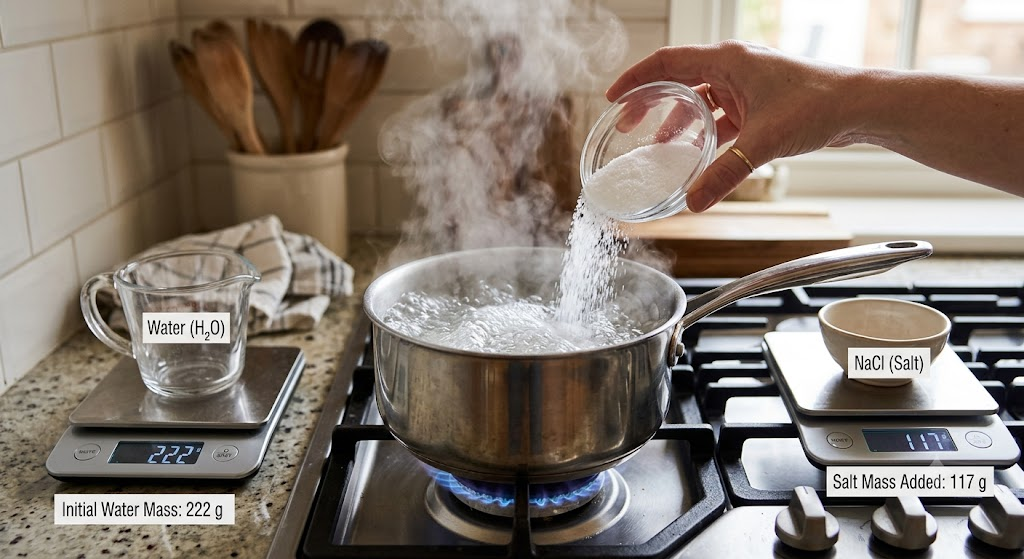
Mass of NaCl: \(117g\)
Mass of water: \(222g=0.222kg\)
Molar mass of NaCl: \(58.5gmol^{-1}\)
Boiling point constant: \(K_b=0.52Kkgmol^{-1}\)
Normal boiling point of water: \(100^\circ C\)
We need to first find the molality, because \(K_b\) is used with molality.
Solution
Step 1: Calculate moles of NaCl
\(\text{Moles of NaCl}=\frac{\text{mass of NaCl}}{\text{molar mass of NaCl}}
\)
Substituting:
\(n=\frac{117}{58.5}
\) \(
n=2mol
\)
Step 2: Calculate molality
Molality is:
\(m=\frac{\text{moles of solute}}{\text{mass of solvent in kg}}
\)
Therefore:
\(m=\frac{2}{0.222}
\) \(
m=9.009molkg^{-1}
\)
Step 3: Calculate boiling point elevation
Use:
\(\Delta T_b=iK_bm
\)
Substitute the values:
\(\Delta T_b=(2)(0.52)(9.009)
\) \(
\Delta T_b=9.37^\circ C
\)
So the boiling point increases by:
\(9.37^\circ C
\)
Step 4: Calculate the new boiling point
\(T_b=\text{normal boiling point}+\Delta T_b
\) \(
T_b=100+9.37
\) \(
T_b=109.37^\circ C
\)
Therefore:
\(T_b = 109.4^\circ C
\)
Final Answer
The chemically correct boiling point is:
\(T_b = 109.4^\circ C
\)