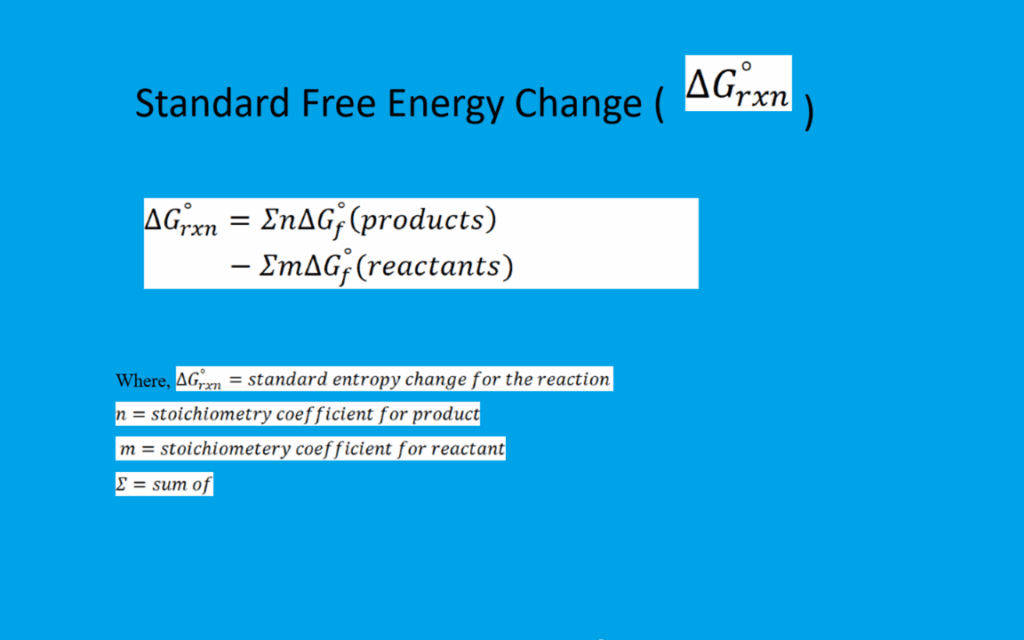
Calculate ΔG° for the following reactions at 25 °C:
(a) \(N_2(g) + O_2(g)\rightarrow 2NO (g)\)
(b)\(H_2O(l) \rightarrow H_2O (g)\)
(c) \(2C_2H_2(g)+ 5O_2(g) \rightarrow 4CO_2(g) + 2H_2O (l)\)
Standard free energy formation value :
| Substance | Standard free energy formation values ( in kJ/mol) |
| N2 (g) | 0 |
| O2 (g) | 0 |
| NO (g) | 86.7 |
| H2O (l) | -237.2 |
| H2O (g) | -228.6 |
| C2 H2(g) | 209.2 |
| CO2(g) | -394.4 |
Interpretation
The quantity we need is the standard Gibbs free energy change of reaction, denoted by \(\Delta G^\circ_{\text{rxn}}\).
Gibbs free energy combines two competing tendencies:
- Enthalpy (\(H\)): systems tend to move toward lower energy.
- Entropy (\(S\)): systems tend to move toward greater disorder.
The relationship is:\(G = H – TS\)
For a chemical reaction under standard conditions,\[
\Delta G^\circ
=
\sum n\,\Delta G_f^\circ(\text{products})
–
\sum n\,\Delta G_f^\circ(\text{reactants})
\]
where:
- \(\Delta G_f^\circ\) = standard Gibbs free energy of formation
- \(n\) = stoichiometric coefficient
A very important fact is that the standard free energy of formation of an element in its most stable standard state is zero. Thus,\(\Delta G_f^\circ(\mathrm{N_2(g)})=0\)\(\Delta G_f^\circ(\mathrm{O_2(g)})=0\)
Standard Gibbs Free Energies of Formation at 25 °C
We use the commonly tabulated values:
| Substance | \(\Delta G_f^\circ\) (kJ mol⁻¹) |
|---|---|
| \(\mathrm{N_2(g)}\) | 0 |
| \(\mathrm{O_2(g)}\) | 0 |
| \(\mathrm{NO(g)}\) | +86.6 |
| \(\mathrm{H_2O(l)}\) | −237.1 |
| \(\mathrm{H_2O(g)}\) | −228.6 |
| \(\mathrm{CO_2(g)}\) | −394.4 |
| \(\mathrm{C_2H_2(g)}\) | +209.2 |
(a) \(\mathrm{N_2(g)+O_2(g)\rightarrow 2NO(g)}\)
Concept Application
Both reactants elements are in their standard states, so their formation free energies are zero.
Solution
Using \[
\Delta G^\circ_{\text{rxn}}
=
\sum n\,\Delta G_f^\circ(\text{products})
–
\sum n\,\Delta G_f^\circ(\text{reactants})
\]
Answer:
Hence, the positive value indicates that formation of NO from nitrogen and oxygen is non-spontaneous under standard conditions.
(b) \(\mathrm{H_2O(l)\rightarrow H_2O(g)}\)
Concept Application
This is simply vaporization of water. The chemical identity remains the same, but the physical state changes.
Solution
Answer:
The positive value means that at 25 °C and standard pressure, liquid water is more stable than water vapor.
(c) \(\mathrm{2C_2H_2(g)+5O_2(g)\rightarrow 4CO_2(g)+2H_2O(l)}\)
Concept Application
This is the combustion of acetylene. Oxygen is an element in its standard state, so its formation free energy is zero.
Solution
First calculate the products:
Now calculate the reactants:
Therefore,
Answer:
The large negative value shows that acetylene combustion is strongly spontaneous under standard conditions.
Final Answers
Insight
A quick way to remember Gibbs free energy calculations is:
Products minus reactants, using formation values.
Also remember the special shortcut:
“Importantly, the standard free energy of formation of any element in its standard state is zero.”
That single fact often eliminates many terms and makes reaction free-energy calculations much easier.