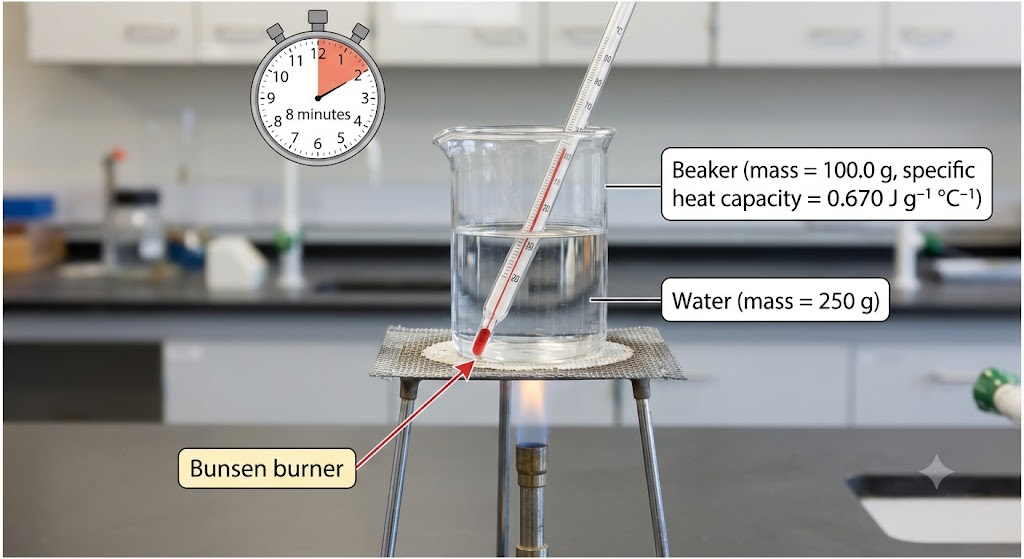
A Bunsen burner flame takes 8 minutes to raise 250 g of water from 20.0°C to 100.0°C when the water is contained in a beaker of mass 100.0 g having a specific heat capacity of 0.670 J g⁻¹ °C⁻¹.
How long will it take to raise the temperature of 200.0 g of glycerine (specific heat capacity = 2.43 J g⁻¹ °C⁻¹) contained in the same beaker from 20.0°C to 80.0°C?
Interpretation
This problem is really about heat energy and heating rate.
A Bunsen burner supplies heat at a constant rate. That means:
Since the same burner is used in both experiments, its heating rate remains unchanged. Therefore, if we know how much heat the burner delivers per minute in the first case, we can determine how long it will take to supply the heat required in the second case.
A common mistake is to calculate the heat needed only for the liquid. The problem clearly states that the glycerine is contained in the same beaker, so the beaker must also be heated. The heat absorbed by the beaker must therefore be included in both situations.
Concept Application
The heat required to raise the temperature of a substance is
where
- = mass
- = specific heat capacity
- = temperature change
The burner’s power can be found from the first experiment:
- Calculate the total heat absorbed by the water and beaker.
- Divide by 8 minutes to obtain the heat supplied per minute.
- Calculate the total heat required for the glycerine and the same beaker.
- Divide by the burner’s heating rate to obtain the required time.
Solution
Step 1: Heat absorbed by water
For the water,
Hence,
Step 2: Heat absorbed by the beaker in the first experiment
For the beaker,
Therefore,
Step 3: Total heat supplied in 8 minutes
Thus the burner supplies
Step 4: Heat required for glycerine
For glycerine,
Hence,
Step 5: Heat required for the beaker in the second experiment
The beaker again rises from to , so
Step 6: Total heat needed
Step 7: Calculate the time
Insight
The key idea is that time is proportional to the total heat required when the heating source remains the same:
Also remember that whenever a container’s mass and specific heat are given, it usually means the examiner expects you to include the container’s heat absorption. Ignoring the beaker often gives an answer that is close, but not fully correct.