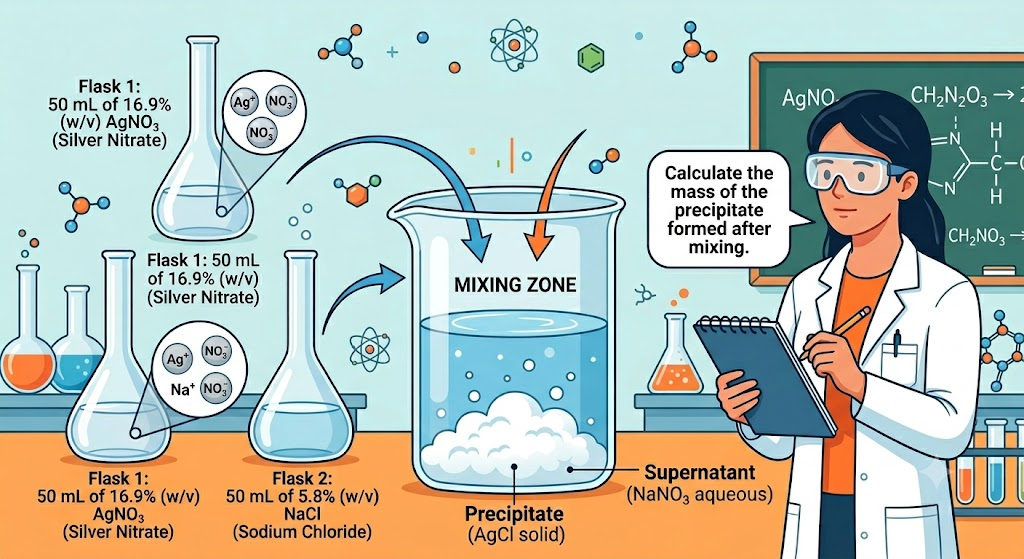
In a mixture of solution, 50 mL of 16.9%(w/v) AgNO3 solution and 50mL of 5.8%(w/v)NaCl solutions are mixed. Calculate the mass of the precipitate formed after mixing.
This is a precipitation reaction problem. When solutions of silver nitrate and sodium chloride are mixed, the ions exchange partners and form silver chloride, which is insoluble in water and therefore precipitates.
The reaction is:
Notice that the stoichiometric ratio between and is 1 : 1. Therefore, the amount of precipitate formed depends on whichever reactant is present in the smaller number of moles (the limiting reagent).
Concept Application
The concentrations are given in %(w/v).
A (w/v) solution means:
So we can directly calculate the mass of each solute present in the given 50 mL portions.
Solution
Step 1: Calculate mass of
Given:
This means:
Therefore, contains:
Step 2: Calculate moles of
Molar mass of :
Hence,
Step 3: Calculate mass of
Given:
Thus,
So mL contains:
Step 4: Calculate moles of
Molar mass of :
Therefore,
Step 5: Identify the limiting reagent
Reaction:
Required ratio:
Available moles:
Since is slightly smaller, it is the limiting reagent.
Hence,
Step 6: Calculate mass of precipitated
Molar mass of :
Therefore,
Answer
Insight
A useful shortcut for precipitation problems is:
Convert %(w/v) directly into grams using the given volume.
Convert grams to moles.
Use the balanced equation to find the limiting reagent.
Calculate the mass of the insoluble product.
Also notice the elegant choice of concentrations here:
These give almost equal moles ( mol each), so nearly all of both reactants are consumed, producing about mol of . This makes the final answer easy to estimate even before doing the detailed calculation.