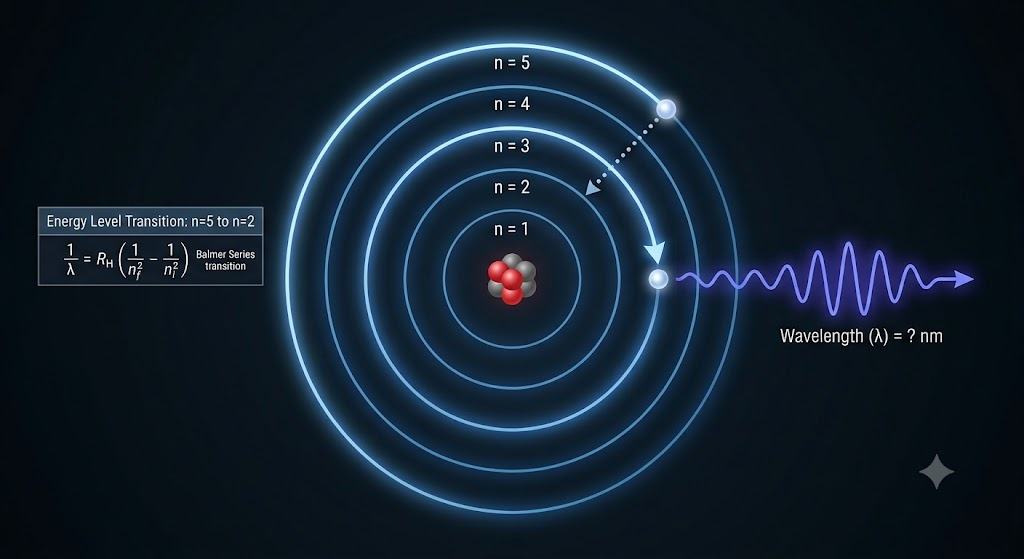
Question
What is the wavelength (in nanometers) of the photon emitted when an electron in a hydrogen atom transitions from the \(n_i=5\) energy level to the \(n_f=2\) energy level?
Interpretation
This question involves the Bohr model of the hydrogen atom, which states that an electron can occupy only specific, quantized energy levels. When an electron moves from a higher energy level to a lower energy level, it loses energy. This lost energy is emitted as a photon.
The energy of each level in the hydrogen atom is given by the Bohr energy equation. The energy change for a transition is\( ΔE = R_H(\frac{1}{n_i^2}-\frac{1}{n_f^2}) \)
where
- \(RH=2.18×10⁻¹⁸ J\) is the Rydberg energy constant,
- \(ni\) is the initial energy level,
- \(nf\) is the final energy level.
A negative value of \(ΔE\) indicates that energy is released (emission), while a positive value indicates that energy is absorbed (absorption).
Once the energy of the photon is known, its wavelength can be calculated using
\( E = \frac{hc}{λ} \)
or
\(λ = \frac{hc}{E} \)
Concept Application
In this problem, the electron moves from\(n_i=5\rightarrow n_f=2\)
Since the electron moves to a lower energy level, this is an emission process.
Although the calculated energy change will be negative, the wavelength of a photon is always positive because wavelength is a physical distance. Therefore, while calculating the wavelength, we use only the magnitude of the energy.
Solution
The energy change is
\( ΔE = R_H(\frac{1}{n_i^2}-\frac{1}{n_f^2}) \)
Substituting the given values,
\( ΔE = (2.18\times10^{-18}(\frac{1}{5^2}-\frac{1}{2^2}) \)
\( = (2.18\times10^{-18}(\frac{1}{25}-\frac{1}{4}) \)
\( = (2.18\times10^{-18})(0.04 – 0.25) \)
\( = (2.18\times10^{-18})(-0.21) \)
\( ΔE = -4.58\times10^{-19}J \)
The negative sign confirms that the photon is emitted.
To calculate the wavelength, use the magnitude of the energy:
\(λ = \frac{hc}{|ΔE|} \)
Substituting the known constants,
\( λ = 4.34\times10^{-7}m \)
Finally, convert meters to nanometers:
Final Answer
\(\ λ=434nm\)
Insight
A simple way to remember electronic transitions is:
- Electron moves down (\(ni>nf\)) → Energy is emitted → \(ΔE<0\)
- Electron moves up (\(ni<nf\)) → Energy is absorbed → \(ΔE>0\)
Also remember that energy and wavelength are inversely related:
\( E = \frac{hc}{λ} \)
This means that a larger energy difference produces a shorter wavelength, while a smaller energy difference produces a longer wavelength. This relationship is fundamental to understanding atomic spectra and is frequently tested in chemistry examinations.