Category: Q&A

  • Calculate Free energy change (delta G) for the following reactions at 25°C:

    free energy change (ΔG) formula

    Calculate ΔG° for the following reactions at 25 °C:

    (a) \(N_2(g) + O_2(g)\rightarrow 2NO (g)\)

    (b)\(H_2O(l) \rightarrow H_2O (g)\)

    (c) \(2C_2H_2(g)+ 5O_2(g) \rightarrow 4CO_2(g) + 2H_2O (l)\)

    Standard free energy formation value :

    SubstanceStandard free energy formation values ( in kJ/mol)
    N2 (g)0
    O2 (g)0
    NO (g)86.7
    H2O (l)-237.2
    H2O (g)-228.6
    C2 H2(g)209.2
    CO2(g) -394.4

    Interpretation

    The quantity we need is the standard Gibbs free energy change of reaction, denoted by \(\Delta G^\circ_{\text{rxn}}\).

    Gibbs free energy combines two competing tendencies:

    • Enthalpy (\(H\)): systems tend to move toward lower energy.
    • Entropy (\(S\)): systems tend to move toward greater disorder.

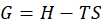
    The relationship is:\(G = H – TS\)

    For a chemical reaction under standard conditions,\[
    \Delta G^\circ
    =
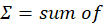
    \sum n\,\Delta G_f^\circ(\text{products})

    \sum n\,\Delta G_f^\circ(\text{reactants})
    \]

    where:

    • \(\Delta G_f^\circ\) = standard Gibbs free energy of formation
    • \(n\) = stoichiometric coefficient

    A very important fact is that the standard free energy of formation of an element in its most stable standard state is zero. Thus,\(\Delta G_f^\circ(\mathrm{N_2(g)})=0\)\(\Delta G_f^\circ(\mathrm{O_2(g)})=0\)


    Standard Gibbs Free Energies of Formation at 25 °C

    We use the commonly tabulated values:

    Substance\(\Delta G_f^\circ\) (kJ mol⁻¹)
    \(\mathrm{N_2(g)}\)0
    \(\mathrm{O_2(g)}\)0
    \(\mathrm{NO(g)}\)+86.6
    \(\mathrm{H_2O(l)}\)−237.1
    \(\mathrm{H_2O(g)}\)−228.6
    \(\mathrm{CO_2(g)}\)−394.4
    \(\mathrm{C_2H_2(g)}\)+209.2

    (a) \(\mathrm{N_2(g)+O_2(g)\rightarrow 2NO(g)}\)

    Concept Application

    Both reactants elements are in their standard states, so their formation free energies are zero.

    Solution

    Using \[
    \Delta G^\circ_{\text{rxn}}
    =
    \sum n\,\Delta G_f^\circ(\text{products})

    \sum n\,\Delta G_f^\circ(\text{reactants})
    \]

    ΔG=2(ΔGf(NO))[0+0]\Delta G^\circ =2(\Delta G_f^\circ(\mathrm{NO})) -[0+0]=2(86.6)=2(86.6)=173.2 kJ mol1=173.2\ \text{kJ mol}^{-1}

    Answer:ΔG=+173.2 kJ mol1\boxed{\Delta G^\circ = +173.2\ \text{kJ mol}^{-1}}

    Hence, the positive value indicates that formation of NO from nitrogen and oxygen is non-spontaneous under standard conditions.


    (b) \(\mathrm{H_2O(l)\rightarrow H_2O(g)}\)

    Concept Application

    This is simply vaporization of water. The chemical identity remains the same, but the physical state changes.

    Solution

    ΔG=ΔGf(H2O(g))ΔGf(H2O(l))\Delta G^\circ =\Delta G_f^\circ(\mathrm{H_2O(g)}) -\Delta G_f^\circ(\mathrm{H_2O(l)})=(228.6)(237.1)=(-228.6)-(-237.1)=+8.5 kJ mol1=+8.5\ \text{kJ mol}^{-1}

    Answer:ΔG=+8.5 kJ mol1\boxed{\Delta G^\circ = +8.5\ \text{kJ mol}^{-1}}

    The positive value means that at 25 °C and standard pressure, liquid water is more stable than water vapor.


    (c) \(\mathrm{2C_2H_2(g)+5O_2(g)\rightarrow 4CO_2(g)+2H_2O(l)}\)

    Concept Application

    This is the combustion of acetylene. Oxygen is an element in its standard state, so its formation free energy is zero.

    Solution

    First calculate the products:4(ΔGf(CO2))+2(ΔGf(H2O(l)))4(\Delta G_f^\circ(\mathrm{CO_2})) +2(\Delta G_f^\circ(\mathrm{H_2O(l)}))=4(394.4)+2(237.1)=4(-394.4)+2(-237.1)=1577.6474.2=-1577.6-474.2=2051.8 kJ=-2051.8\ \text{kJ}

    Now calculate the reactants:2(ΔGf(C2H2))+5(ΔGf(O2))2(\Delta G_f^\circ(\mathrm{C_2H_2})) +5(\Delta G_f^\circ(\mathrm{O_2}))=2(209.2)+5(0)=2(209.2)+5(0)=418.4 kJ=418.4\ \text{kJ}

    Therefore,ΔG=(2051.8)(418.4)\Delta G^\circ =(-2051.8)-(418.4)=2470.2 kJ mol1=-2470.2\ \text{kJ mol}^{-1}

    Answer:ΔG=2470.2 kJ mol1\boxed{\Delta G^\circ = -2470.2\ \text{kJ mol}^{-1}}

    The large negative value shows that acetylene combustion is strongly spontaneous under standard conditions.


    Final Answers

    N2(g)+O2(g)2NO(g)\boxed{\mathrm{N_2(g)+O_2(g)\rightarrow 2NO(g)}}ΔG=+173.2 kJ mol1\boxed{\Delta G^\circ = +173.2\ \text{kJ mol}^{-1}}H2O(l)H2O(g)\boxed{\mathrm{H_2O(l)\rightarrow H_2O(g)}}ΔG=+8.5 kJ mol1\boxed{\Delta G^\circ = +8.5\ \text{kJ mol}^{-1}}2C2H2(g)+5O2(g)4CO2(g)+2H2O(l)\boxed{\mathrm{2C_2H_2(g)+5O_2(g)\rightarrow 4CO_2(g)+2H_2O(l)}}ΔG=2470.2 kJ mol1\boxed{\Delta G^\circ = -2470.2\ \text{kJ mol}^{-1}}

    Insight

    A quick way to remember Gibbs free energy calculations is:

    Products minus reactants, using formation values.

    Also remember the special shortcut:

    “Importantly, the standard free energy of formation of any element in its standard state is zero.”

    That single fact often eliminates many terms and makes reaction free-energy calculations much easier.
  • For the autoionization of water at 25°C, what is ΔG° for the process?

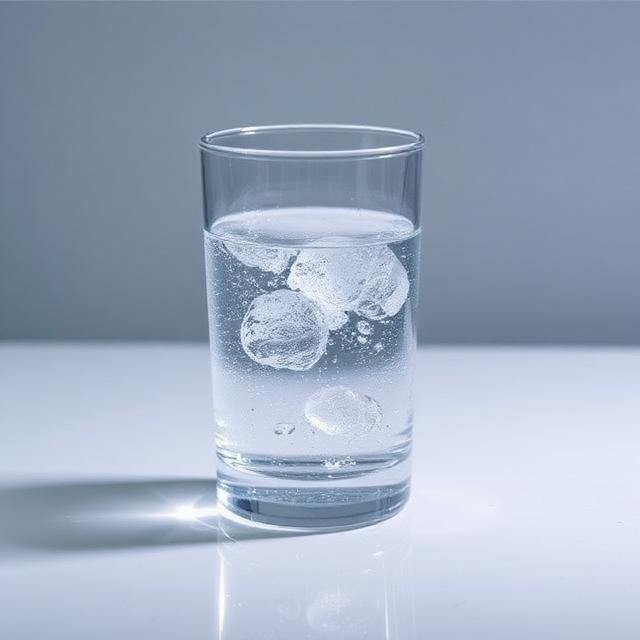
    Pure water captured in a transparent glass

    For the autoionization of water at 25°C,

    H2O (l) ⟺ H+(aq) + OH (aq)

    kw= 1.0 × 10⁻¹⁴ . What is ΔG° for this process?

    Interpretation

    The autoionization of water is the process in which a small fraction of water molecules transfer a proton to one another, producing hydrogen and hydroxide ions:\(\mathrm{H_2O(l)\rightleftharpoons H^+(aq)+OH^-(aq)}\)

    The key idea in this problem is the connection between equilibrium and thermodynamics. The equilibrium constant tells us how far a reaction proceeds, while the standard Gibbs free energy change tells us whether the reaction is thermodynamically favorable under standard conditions.

    These quantities are related by:\(\Delta G^\circ = -RT\ln K\)

    where:\(R = 8.314\ \mathrm{J,mol^{-1},K^{-1}}\)

    and

    \(T\) is the absolute temperature.

    Because the ionization constant of water is extremely small,\(K_w = 1.0\times10^{-14}\)

    we already expect the forward reaction to be unfavorable under standard conditions. Therefore, the answer should come out as a positive value of \(\Delta G^\circ\).


    Concept Application

    For the given equilibrium,\(\mathrm{H_2O(l)\rightleftharpoons H^+(aq)+OH^-(aq)}\)

    the equilibrium constant is:\(K = K_w = 1.0\times10^{-14}\)

    The temperature is:\(T = 25^\circ\mathrm{C} = 298.15\ \mathrm{K}\)

    Substituting these values into the Gibbs free energy equation will directly give the standard free energy change for the autoionization process.


    Solution

    Using\(\Delta G^\circ = -RT\ln K_w\)

    Substituting the numerical values,\(\Delta G^\circ = -(8.314)(298.15)\ln(1.0\times10^{-14})\)

    Now evaluate the logarithmic term:\(\ln(1.0\times10^{-14}) = -14\ln 10\)

    Since\(\ln 10 = 2.303\)

    we obtain\(\ln(1.0\times10^{-14}) = -14(2.303) = -32.24\)

    Substituting back,\(\Delta G^\circ = -(8.314)(298.15)(-32.24)\)\(\Delta G^\circ = 79.9\times10^4\ \mathrm{J,mol^{-1}}\)

    Converting joules to kilojoules,\(\Delta G^\circ = 79.9\ \mathrm{kJmol^{-1}}\)

    Therefore,\(\Delta G^\circ = +79.9\ \mathrm{kJmol^{-1}}\)


    Insight

    A useful relationship to remember is:

    • If \(K>1\), then \(\Delta G^\circ<0\)
    • If \(K<1\), then \(\Delta G^\circ>0\)

    Since water has an extremely small ionization constant, \(K_w=10^{-14}\), the equilibrium lies overwhelmingly toward molecular water. The large positive value of \(\Delta G^\circ\) is simply the thermodynamic expression of that fact.

    Final Answer:\(\\Delta G^\circ = +79.9\ \mathrm{kJmol^{-1}}\)

  • Calculate Kp for the reaction H2 (g) + I2 (g) ⇄ 2HI (g) at 25°C

    Calculate Kp for the reaction H2 (g) + I2 (g) ⇄ 2HI (g) at 25°C

    Calculate Kp for the below reaction at 25°C:

    Solution:

    Interpretation: We will use the equation that describes the relation between equilibrium constant (Kp ) and Gibb’s free energy change (ΔG°).

    ΔG° = – RTlnKp

    Where, ΔG° = Standard free energy change

    Kp = Equilibrium constant in terms of pressure

    Given: ΔG° = 2.60 kJ/mol

    Solution: ΔG° = – RTlnKp

    Therefore, Kp for the reaction, H2 (g) + I2 (g) ⇄ 2HI (g) is 0.35 .

  • Determine the standard entropy changes for the following reactions at 25 degree Celsius:

    Determine the standard entropy changes for the following reactions at 25 degree Celsius:

    Determine the standard entropy changes for the following reactions at 25° C:

    (a) H2 (g) + CuO(s) → Cu(s) + H2O(g)

    (b) 2 Al (s) + 3 ZnO (s) → Al2O3 (s) + 3 Zn (s)

    (c) CH4 (g) + 2 O2 (g) → CO2 (g) + 2 H2O (l)

    Standard entropy values:

    SubstanceStandard Entropy (S°) (J/(K·mol))
    Cu (s)33.3
    CuO (s)43.5
    H2(g)131
    H2O(g)188.7
    Al(s)28.33
    ZnO(s)43.9
    Zn(s)41.6
    Al2O3(s)50.99
    CH4(g)186.2
    O2(g)205.0
    CO2(g)213.6
    H2O(l)69.9

    Interpretation: The standard entropy changes for a reaction, ∆S°rxn, is given by the difference in standard entropies between products and reactants. Thus, it reflects the change in disorder or randomness during the reaction.

    We can calculate Standard entropy changes by using the following formula:

    Where, ∆S°rxn = Standard entropy change for the reaction

    Solution:

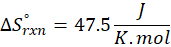
    (a) H2 (g) + CuO(s) → Cu(s) + H2O(g)

    Therefore, the entropy increases by 47.5 J/K.mol for the reaction H2 (g) + CuO(s) → Cu(s) + H2O(g)

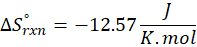
    (b) 2 Al (s) + 3 ZnO (s) → Al2O3 (s) + 3 Zn (s)

    Therefore, the entropy decreases by – 12.57 J/K.mol for the reaction 2 Al (s) + 3 ZnO (s) → Al2O3 (s) + 3 Zn (s).

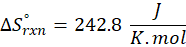
    (c) CH4 (g) + 2 O2 (g) → CO2 (g) + 2 H2O (l)

    Therefore, the entropy increases by 242.8 J/K.mol for the reaction CH4 (g) + 2 O2 (g) → CO2 (g) + 2 H2O (l).

  • Calculate ∆G° for the following reactions at 25°C.

    Calculate ∆G° for the following reactions at 25°C.

    Calculate ∆G° for the following reactions at 25° C:

    (a) N2 (g) + O2 (g) → 2 NO (g)

    (b) H2O (l) → H2O (g)

    (c) 2 C2H2 (g) + 5 O2 (g) → 4CO2 (g) + 2H2O (l)

    Standard free energy formation values:

    Standard free energy formation (ΔG°f)kJ/mol
    N2 (g)0
    O2 (g)0
    NO (g)86.7
    H2O (l)-237.2
    H2O (g)-228.6
    C2H2 (g)209.2
    CO2(g)-394.4

    Interpretation

    To express the spontaneity of a reaction more clearly, we introduce thermodynamics’ function called Free energy or Gibb’s free energy (G). It is the energy available in the system to do useful work.

    Gibb’s free energy is defined as a thermodynamic equation equal to the enthalpy of a system, minus the product of the entropy and the temperature of the system.

    Where, G = Gibb’s free energy

    The value of Gibb’s free energy (G) is expressed in Joules or Kilojoules

    Formula

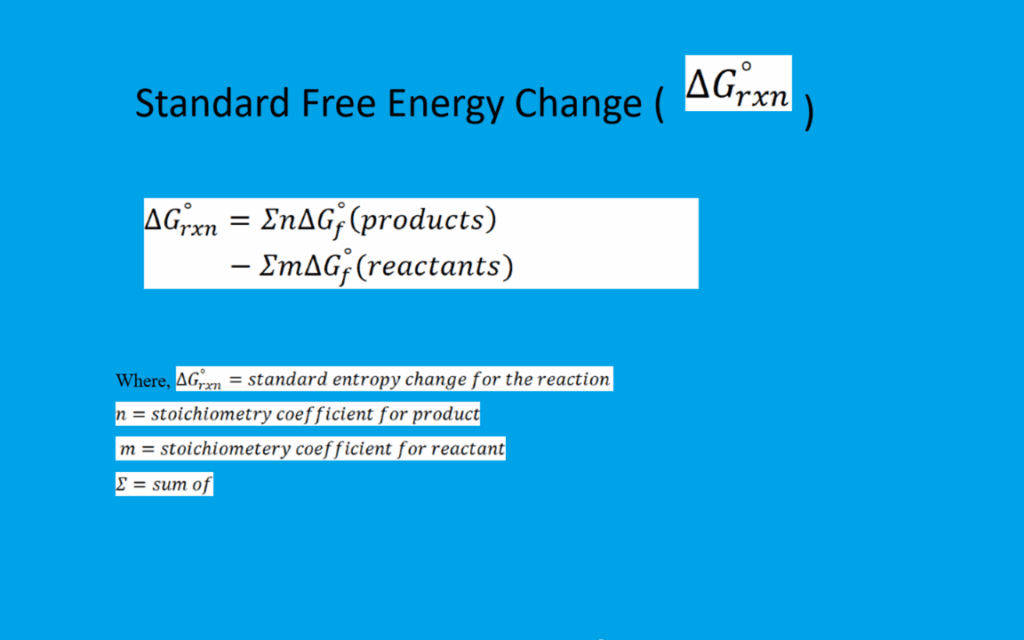
    We can calculate standard free energy change by using the following formula:

    Where,

    Solution:

    (a) N2 (g) + O2 (g) → 2 NO (g)

    Therefore, ∆G°rxn for the reaction N2 (g) + O2 (g) → 2 NO (g) is 173.4 kJ/mol.

    (b) H2O (l) → H2O (g)

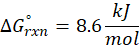
    Therefore, ∆G°rxn for the reaction H2O (l) → H2O (g) is 8.6 kJ/mol.

    (c) 2 C2H2 (g) + 5 O2 (g) → 4CO2 (g) + 2H2O (l)

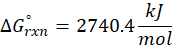
    Therefore, ∆G°rxn for the reaction 2 C2H2 (g) + 5 O2 (g) → 4CO2 (g) + 2H2O (l) is 2740.4 kJ/mol.

  • Which of the following processes occur spontaneously, and which occur non-spontaneously?

    Which of the following processes occur spontaneously, and which occur non-spontaneously?

    Which of the following processes occur spontaneously, and which occur non-spontaneously?

    1. Dissolving table salt (NaCl) in a steaming bowl of soup
    2. Electric current flowing from lower potential to higher potential
    3. Climbing Mount Everest
    4. Releasing the fragrance of perfume by simply removing the cap
    5. Isolating helium and neon from a mixture of gases

    Interpretation

    Here, we aim to identify which processes happen spontaneously and which do not. The key to understanding this lies in the fact that spontaneous processes occur naturally, without any external energy, while non-spontaneous processes need additional energy or effort to take place. By following this principle, we should be able to identify the spontaneous and non-spontaneous nature of the following processes.

    a. Dissolving table salt (NaCl) in a steaming bowl of soup

    When we add table salt (NaCl) to a steaming bowl of soup, the hot soup speeds up the dissolving of salt and does not require any external energy. Thus, this process is spontaneous as it does not require any external energy or effort and occurs naturally.

    b. Electric current flowing from lower potential to higher potential

    We know that electric current naturally flows from higher potential to lower potential. To make it flow in the reverse direction i.e., from lower potential to higher potential, an external energy source such as a power supply or battery is required. Since this process doesn’t happen by itself and needs an external energy source, it is considered a non-spontaneous process.

    c. Climbing Mount Everest

    Climbing Mount Everest requires preparation, extra effort, and energy, it does not happen naturally like rolling down a hill. Therefore, this is a non-spontaneous process.

    d. Releasing the fragrance of perfume by simply removing the cap

    As we open a perfume bottle, the fragrance naturally spreads into the surrounding air. We don’t need to provide any extra energy to make this happen. Therefore, this is a spontaneous process.


    e. Isolating helium and neon from a mixture of gases

    We require special methods like fractional distillation and specialized tools to separate helium and neon from a gaseous mixture. Thus, this is a non-spontaneous process as it does not occur naturally and requires external energy.

  • How does the entropy of a system change ?

    How does the entropy of a system change ?

    How does the entropy of a system change in each of the following processes?

    1. Melting of solid
    2. Freezing of liquid
    3. Boiling of liquid
    4. Conversion of vapor to solid
    5. Condensation of vapor to liquid
    6. Sublimation of solid
    7. Dissolution of urea in water

    Entropy

    In Thermochemistry, entropy is the degree of randomness or disorder in a system. The greater the degree of randomness, the higher the entropy, and vice versa. Entropy describes the spontaneous changes that occur in everyday life or the tendency of the universe towards disorder.

    For example, In the morning, when you clean your room and arrange everything neatly, the system has a higher order, however, as you begin your daily activities, especially cooking, things get messy. This is an example of how entropy initially appears lower in an organized state, but as disorder increases and things become more chaotic, the entropy increases.

    Entropy is a thermodynamic function that depends on the system’s state rather than the pathway followed. Entropy is an extensive property that scales with the system’s size or extent.

    Interpretation

    When we increase the temperature, entropy increases. Adding more energy to a system causes the molecules to become more excited, leading to greater randomness. The more random the system, the higher the entropy. Now, let’s determine the change in entropy for the following scenarios:

    a. Melting of solid:

    In its solid state, ice has molecules fixed in an ordered structure. As it begins to melt, the molecules gain mobility, leading to increased disorder and consequently greater randomness. A higher degree of randomness corresponds to higher entropy. Since the liquid state is more disordered than the solid state, the system’s entropy increases when ice melts.

    b. Freezing of liquid

    When a liquid freezes, its molecules become more ordered, resulting in a solid with a fixed structure and less randomness. As a result, the degree of disorder decreases. Hence, entropy decreases during the freezing process of liquid.

    c. Boiling of liquid

    When a liquid begins to boil, the molecules gain more freedom to move independently, which leads to an increase in randomness. The more random a system, the higher its entropy. Since the gaseous state is more random than the liquid state, entropy increases when the liquid turns into gas.

    d. Conversion of vapor to a solid

    When vapor turns into a solid, the molecules have less freedom to move, causing the level of randomness to decrease. As a result, entropy decreases because the water molecules are more organized in the solid state than the vapor state.

    e. Condensation of vapor to liquid

    Vapor molecules have more free space to move compared to liquid molecules. Molecules become more organized when the vapor turns into liquid and the randomness decreases. Therefore entropy decreases.

    f. Sublimation of solid

    When solid sublimes, it is converted to vapor state. As molecules are more ordered in the solid state than the gaseous state, the randomness in the gaseous state is greater, and therefore entropy increases.

    g. Dissolution of urea in water

    When urea dissolves in water, it forms solid crystals or pellets and is highly soluble. The process of dissolving urea involves transitioning from a more ordered solid state to a less ordered liquid state. As the urea dissolves, the randomness increases, resulting in increased entropy.

  • What is meant by a spontaneous process? Provide four examples of spontaneous and non-spontaneous process.

    What is meant by a spontaneous process? Provide four examples of spontaneous and non-spontaneous process.

    A spontaneous process is one that occurs naturally and without the need for external intervention, under appropriate conditions. In other words, we can say it happens on its own under specific circumstances.

    While a nonspontaneous process does not occur naturally and requires some external influence or energy to take place.

    Four examples of both processes are:

    Spontaneous processes:

    • Water flowing downhill: When water flows from a higher place to a lower place, like a river running downhill, it naturally happens due to gravity, without needing extra energy.
    • Ice melting at room temperature: Ice will naturally melt into water above 0°C. It doesn’t need anything extra to make this happen.
    • A rock rolling down a hill: If a rock is placed at the hilltop, it will naturally roll down due to gravity, without needing any external force to make it move.
    • Rusting of iron: When iron is exposed to air and moisture, it will slowly rust (form iron oxide) over time. This is a spontaneous process that occurs naturally.
    Water flowing downhill - Spontaneous Process
    Water flowing downhill – Spontaneous Process

    Non-spontaneous processes:

    • Water flowing uphill: For water to flow uphill, we need to pump it or apply energy (like in a fountain). Water doesn’t flow uphill by itself.
    • Freezing of water at room temperature: Water will only freeze into ice if we put that below 0°C. At room temperature, this does not happen naturally, and energy must be removed from the water to make it freeze.
    • Unmixing of a solution: If we mix sugar in water, the sugar dissolves. For the sugar to separate back out on its own, energy would need to be added, such as by evaporating the water.
    • Charging a battery: A battery cannot charge itself. We need to connect it to an external power source to add energy and recharge it.
  • Calculate the total heat required to convert 25.0g of ice at -10 degrees Celsius to 25.0 g of water at +10 degrees Celsius.

    Calculate the total heat required to convert 25.0g of ice at -10 degrees Celsius to 25.0 g of water at +10 degrees Celsius.

    Interpretation:

    This concept comes under Thermochemistry. This involves energy transfer and phase changes as the ice undergoes different stages—from being solid at lower temperatures to becoming liquid at higher temperatures.

    To understand how heat is involved in these changes, we need to break down the underlying processes involved in temperature change, phase change, and the heat energy required at each step.

    1. Sensible Heat and Temperature Change

    Sensible heat is the heat energy required to change the temperature of a substance without changing its phase. In this case, we heat ice from -10°C to 0°C, which means the temperature of the solid ice increases.

    The formula gives the heat required to achieve this temperature change:

    Q=m⋅c⋅ΔT

    Where:

    • Where, Q = heat energy
    • m = mass
    • c = specific heat
    • ΔT = temperature change

    Ice’s specific heat is about 2.09 J/g°C. This means that to increase the temperature of 1 gram of ice by 1°C, 2.09 joules of energy are required.

    2. Latent Heat and Phase Change (Melting Ice)

    When the ice reaches 0°C, it will melt into water. Melting is a phase change, where the substance changes from solid to liquid. This transition occurs without a temperature change but requires a specific amount of energy to break the bonds between the ice molecules.

    This energy is called latent heat (the heat required for a phase change), and for ice, it’s referred to as latent heat of fusion. The formula for latent heat is:

    Q = n ΔH

    Where, n= number of moles

    ΔH = heat of fusion or vaporization depending on phase change

    ΔH fusion= 6.02 kJ/mol

    The temperature does not change during this process instead all the energy goes into breaking the bonds between the ice molecules, allowing them to transition into liquid form.

    3. Sensible Heat in Water and Further Heating

    Once the ice melts and turns into water, we can increase the temperature of the liquid water. Heating water requires sensible heat, just as it did for the ice; however, it involves a different value for the specific heat capacity.

    Therefore, in this case, we heat the water from 0°C to 10°C. Consequently, the heat energy required for this temperature change is again calculated using:

    Q=m⋅c(water)⋅ΔT

    Where:

    • Q = heat energy
    • m = mass
    • c = specific heat
    • ΔT = temperature change
    • Cliquid= 4.21 J/g°C

    Given:

    Mass of ice =25.0 g

    Temperature of ice = -10° C

    Mass of water = 25.0 g

    Temperature of water = +10° C

    Step-by-step-solution

    Since the molar mass of ice and water is the same and the given mass is also the same, the number of moles of both will be equal.

    Step 1: To Find moles of ice:

    Molar mass =18.015 g/mol

    Moles=25.0 g x \(\frac{1mol}{18.05 g}\) = 1.388 mol ice

    Moles of ice = Moles of water =1.388 mol

    Step 2: Initially, Ice has a temperature of -10° C and it is converted to liquid water at a temperature of +10° C.

    As a result, we will calculate three different heat values.

    • Heat required for temperature change from -10° C to 0° C, i.e. Q1
    • The heat required for phase change at 0° C solid ice to liquid water, i.e. Q2
    • Heat required for a temperature change from 0° C liquid water to +10° C liquid water, i.e. Q3

    Calculation of three different heat:

    1. To find heat required for a temperature change from -10° C to 0°C (Q1): Q1=m(ice) × C(ice) × [T (final) – T(initial)]

    Q1 = 25.0 g × 2.09 J/g °C × [0° C-(-10° C)] =522 J or 0.522 kJ

    2. To find heat required for temperature change at 0° C solid ice to 0°C liquid water(Q2): Q2=n(ice) × ΔH(fusion)

    Q2= 1.388 mol × 6.02 kJ/g °C = 8.36 kJ

    3. To find heat required for a temperature change from 0 °C to +10°C (Q3): Q3=m(water) × C(water) × [T (final) – T(initial)]

    Q3= 25.0 g × 4.21 J/g °C × [10° C-(0° C)] =1052J 0r 1.05 kJ

    Step :3

    Therefore, the total heat required for the complete transition is the sum of the heat required for each individual transition step.

    Q(Total) = Q1 + Q2 + Q3

    = 0.522 kJ + 8.36 kJ + 1.05 kJ

    = 9.93 kJ

    Hence, the total heat required to convert 25.0 g of ice at – 10° C to 25.0 g of water at – 10° C is 9.93 kJ.